|
Hole #1:
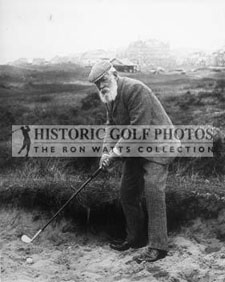
Old Tom Morris 1821 - 1908
|
- Old Tom was born at St Andrews in
1821 and competed in every Open championship up to and
including 1896. He also won the Open four times and
remains the oldest ever winner, having won in 1867
aged 46. Old Tom died at St Andrews in 1908, and is
commemorated, amongst other ways, in the name of the
final hole at the Old Course.
-
Tom Morris was born and bred in St
Andrews, on the east coast of Scotland. He began his
career as an apprentice feather ball maker with Allan
Robertson with whom he worked for 12 years until 1849,
when the new gutta ball took away their livelihood.
-
- Morris was Keeper of the Greens in
Prestwick from 1851 until 1864. In 1860 Old Tom Morris
was instrumental in starting an annual tournament -
The British Open. Old Tom won four Open Championships
in the eighteen sixties, (1861, 1862, 1864 and 1867)
and is still the oldest person to have won the event
at the age of 46.
-
Old Tom was famed for his course
design; his fee: "£1 a day plus expenses. He
played a part in the design of many famous courses,
including Prestwick, Royal Dornoch, Muirfield,
Carnoustie, Royal County Down, Nairn and Cruden Bay.
More than any man of his time, Old Tom left his
imprint on the game. At the Old Course [at St.
Andrews] he helped devise the first metal cups for
firming up the hole; he discovered how sand, scattered
over bare spots, encouraged the growth of grass. He
crossed the British Isles by donkey cart, train and
steamer, laying out golf courses as obscure as
Askernish and as renowned as Muirfield and Royal
Dornoch. He even invented the double-loop routing of
nine holes to a side that is now standard.
-
- As a player, Old Tom was known for
good course management and accuracy from tee to green.
His weakness was the short putt, suggesting that he
patented the yips as well. A letter was once addressed
to THE MISSER OF SHORT PUTTS, PRESTWICK, and the
document was promptly delivered to Morris.
Old Tom's clubmaking business was
established in 1867 by the side of the 18th green of The
Old Course. Old Tom Morris died in the year 1908 aged 86.
Tom had gained so much respect, that his funeral
procession itself spanned the length of South Street in
St Andrews.
|
|
Hole #2:
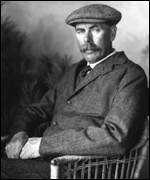
James Braid (1870-1950)
|
- James Braid was a Scotsman from
Earlsferry (not far from St. Andrews). He was a
self-taught golfer, but he taught many others. He
played down his own skill at the game, even though he
was the first to establish a record of five British
Open wins. He was a British National Champion, a
clubmaker of some skill, a club professional for many
years at various clubs, a course designer (nearly 350
of them) and a co-founder of the Professional Golfers
Association (of Britain),
-
- James Braid was a fierce
competitor whether in stroke play or in match play, in
which he excelled. The name "Braid" in Scottish means
"an attack" and that is what he did when he played the
game. He set records and he often won by margins akin
to those of Tiger Woods today. It wasn't uncommon for
the golf correspondent covering a match play
championship to report, "Braid is in the Final! I
believe there is someone else in it too!"
-
- During his career he had to face
the stiffest form of competition in Harry Vardon and
J. H. Taylor, fondly known as The Great Triumvirate.
These 3 British players won 16 of the 21 Open
Championships between 1984 and 1914
|
|
Hole #3:
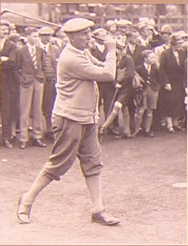
Harry Vardon
|
- Born in Grouville, Harry Vardon
became one of the most famous golfers the game has
ever seen and was known to say 'Don't play too much
golf. Two rounds a day are plenty.'
-
- He started out life as a gardener,
but it was his ability on, not with, the green that
made Vardon famous, and during his sporting career he
won six Open Championships - a feat still
unmatched.
- Remembered as the leading member
of golf's 'triumvirate', he dominated the Open at the
turn of the 20th century alongside J H Taylor and
James Braid. Together, the three men won 16 of the 21
Open Championships between 1984 and 1914 and did much
to establish golf as an international
sport.
-
- Despite the fact that the
implements he played with were primitive by modern
standards, he was the straightest player who ever
lived. In one stretch, for example, he is reported to
have played seven consecutive tournament rounds
without once hitting the ball off the fairway. When he
first visited the US at the turn of the century, his
accuracy was so confounding that it nurtured the
famous mythological story that Harry never liked to
play the same course twice the same day: on his
afternoon round he would have to play out of the divot
marks he had made that morning his first time around!
-
- Vardon was known for his accurate
drives and his introduction of the overlapping grip on
the golf club. Although he did not invent the grip, he
certainly popularized it. Known worldwide as the
Vardon grip, it is still used by 70 per cent of
golfers.
-
- Every year the Vardon trophy is
awarded to the player on the PGA Tour with the lowest
stroke average.
-
|
|
Hole #4:
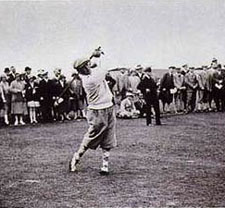
Bobby Jones (1902-1971)
|
- Bobby Jones, an American golfer,
was one of the greatest players in the history of the
sport. In 1930, Jones became the only player ever to
win the United States Open, the British Open, the
United States Amateur, and the British Amateur
tournaments in one year. These were the world's four
major golf events at that time. After completing this
"Grand Slam," Jones retired from tournament play at
the age of 28.
-
- Between 1923 and 1930, Jones won
13 major titles. In addition to his Grand Slam, he won
the U.S. Open in 1923, 1926, and 1929; the British
Open in 1926 and 1927; and the U.S. Amateur in 1924,
1925, 1927, and 1928.
-
- Bobby Jones was well known for his
sense of humor: on being told it was more than 100
degrees in the shade, he replied -- "Well, I'm glad we
don't have to play in the shade."
Jones was born in Atlanta, Ga. His
full name was Robert Tyre Jones, Jr. After his
retirement, Jones and banker Clifford Roberts founded the
Augusta National Golf Club in Augusta, Ga. In 1934, Jones
and Roberts established an annual tournament for the
course … the Masters..
|
|
Hole #5:
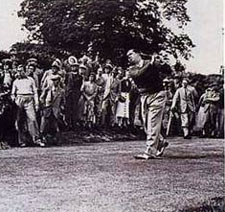
Walter Hagen (1892 - 1969 )
|
- Generally regarded as the greatest
match player ever, "The Haig" won five PGA
Championships at match play, four in a row from
1924-1927 with a string of 22 consecutive match-play
victories. He also won most of the challenge matches
he played against the top players of his day,
including a 12 and 11 defeat of Bobby Jones in a
72-hole match in 1926. Hagen also won the British Open
four times and the U.S. Open twice from 1914 to '29.
After his second U.S. Open victory, in 1919, he became
the world's first full-time tournament professional
and was the first to earn more than $1 million playing
the game. Because of his spirit for the game and
lavish lifestyle, he is credited with doing more than
anyone else to raise the societal status of the golf
professional.
-
- Walter Hagen was a great golfer
and the player most responsible for elevating
professional golf into a major sport. Hagen's
insistence on first-class treatment at tournaments
raised the stature of professional golfers during a
time when amateur players dominated the game. His
popularity greatly contributed to making golf a
spectator sport.
-
- Hagen's skill as a player combined
with his showmanship and colorful lifestyle to make
him golf's first celebrity. Hagen sometimes arrived
for a match in a chauffeur-driven limousine and
wearing a tuxedo. He was the first golfer to earn more
than a million dollars in tournaments and exhibitions
and the first player to market golf equipment bearing
his name.
-
Walter Charles Hagen was born in
Rochester, N.Y. Between 1914 and 1929, he won 11 major
tournaments. He won the United States Open in 1914 and
1919; the British Open in 1922, 1924, 1928, and 1929; and
the Professional Golfers' Association (PGA) tournament in
1921, 1924, 1925, 1926, and 1927.
|
|
Hole
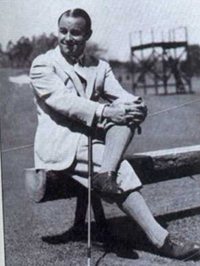
#6: Gene Sarazen
|
- Sarazen was the first golfer to
win all four modern-day majors -- the Masters, U.S.
Open, British Open and PGA Championship -- and was one
of the youngest winners of a major, taking the U.S.
Open in 1922 at age 20. A championship career that
spanned more than 50 years produced seven major titles
in all and one of the most famous shots in the history
of the game: a double eagle on the 15th hole at
Augusta National Golf Club in the final round of the
'35 Masters. It got him into a 36-hole playoff that he
won the next day. Sarazen also earned the lasting
gratitude of golfers everywhere by inventing the sand
wedge in 1931.
-
-
|
|
Hole
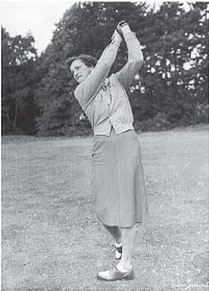
#7: Babe Didrikson Zaharias, (1911-1956)
|
- Mildred Ella Didrikson was born in
Port Arthur, Texas. She was nicknamed Babe after
baseball slugger Babe Ruth because of the many home
runs she hit playing baseball as a child. Babe
Didrikson Zaharias is generally considered the
greatest woman athlete in sports history. She gained
her most enduring fame in golf and track and field,
but she also competed in basketball, baseball, pocket
billiards, tennis, diving, and swimming. At the 1932
Olympic Games, she set world records in the 80-meter
hurdles, the javelin throw, and the high
jump.
-
Didrikson began concentrating on golf
in the early 1930's. Her style of play dramatically
changed women's golf. Her powerful swing, low scores, and
showmanship attracted many new fans to women's golf.
Didrikson won the U.S. Women's Amateur tournament in
1946. In 1946 and 1947, she won 17 tournaments in a row,
including the 1947 British Women's Amateur tournament.
She was one of the founders of the Ladies Professional
Golf Association (LPGA). She won the U.S. Women's Open in
1948, 1950, and 1954.
|
|
Hole #8:
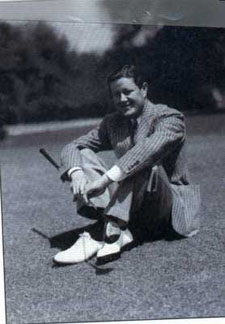
Byron Nelson
|
- Born in Texas, USA, Nelson is
remembered as one of the most consistent golfers of
all time. Nelson's is a remarkable story. He grew up
close to Ben Hogan and both men caddied at the same
golf club. Although Nelson turned professional in
1932, it would be five years before he won his first
Major, the US Masters.
-
- During the 1940s, he played in 133
tournaments and was in the money list in every one of
them. At that time that meant the top 10. He had 11
consecutive wins in 1945 and won the PGA Championship.
He was also that year's leading money earner.
According to Ben Crenshaw "Byron's 11 straight
victories (in 1945) will never be
matched."
- The story goes that his wife
suggested that he played golf in order to raise the
money to buy their own ranch rather than touch their
savings. Nelson achieved that goal in 1946 and he
retired at age 34 to become a farmer in his native
Texas.
-
- On the short list of records that
never will be broken, Nelson would seem to own two. In
1945, he won 18 of 30 tournaments he played, including
11 in a row, in a torrid season no one has seriously
approached since. He averaged 68.33 strokes per round
that year, an average that never has been bettered.
|
|
Hole #9:
Ben Hogan, (1912-1997)
|
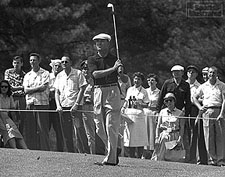
- Ben Hogan, an American golfer, was
one of the greatest players in the history of the
sport. Hogan won more than 60 tournaments, including
the United States Open four times, the Professional
Golfers' Association (PGA) tournament twice, the
Masters twice, and the British Open once.
-
- In 1949, a bus struck the car
Hogan was driving. The collision fractured his left
collarbone, left ankle, pelvis, and a rib. Hogan
barely survived the injuries. Doctors feared he might
not be able to walk again, much less play golf. Yet,
just 17 months after the accident, Hogan won the 1950
U.S. Open. He played the tournament with his legs
wrapped in bandages. Hogan was one of the smallest
golf champions, weighing only 135 pounds (61.2
kilograms).
-
Hogan, through his own diligence,
became the finest shotmaker ever in the game and one of
just five men -- Gene Sarazen, Jack Nicklaus, Gary Player
and Tiger Woods are the others -- who achieved a career
grand slam of at least one victory in each of the four
modern major championships: the Masters, U.S. Open,
British Open and PGA Championship. He was the
hardest-working player in the game during a career that
earned 63 victories on the PGA Tour, third-best in tour
history, and nine major championships, fourth-best behind
Nicklaus, Bobby Jones and Walter Hagen. He also was
probably the least-known star in sport because of a
stern, no-nonsense exterior that scared away outsiders.
Because he was reluctant to leave his Fort Worth, Texas,
home after he retired, he was seldom seen the last 30
years of his life.
|